
「窯」,表示燒製瓦器的地方,本義:燒磚瓦陶瓷器的灶,我們取其燒製含義在此處作為醞釀和創造的過程,希望創作者以及觀眾在經歷此地的淬煉後能以嶄新的姿態離開。
「座」,在詞語解釋上有「托底」之意, 為器物的基礎部分,我們希望能成為創作者的基底,成為⽀撐的那⼀⽅。
但這個是官(騙)方(人)版本,怕正(給)經(錢)單位皺眉所以編造了花言巧語版。
時間回到開業前,負責人A(以下簡稱A)剛脫離學校環境走入社會,正是憤世年少時期。那時候他看什麼都不順眼、做什麼都很絕望,甚至連要經營一個空間都覺得大眾對台中的刻板印象是聲色場所林立、魚龍混雜,「在這樣一個文化都不知道去哪找的地方,不然就叫做窯子吧,反正藝術家也是來賣身賣藝的」,A半開玩笑這麼說。當時在台北的負責人B(以下簡稱B)對此還一無所知,直到看到網路上開始稱這個空間窯的時候才發現已經一發不可收拾,以下截錄一些當時B的吐血語錄:
「相由心生誒,這個名字太難聽了吧!」
「萬一要寫補助、要去找贊助,你會給一個叫窯子的空間嗎!」
「我可以賣藝不賣身啊,為什麼會是妓院啦X!」
當時已經有很多人以窯代稱空間了,B再怎麼力往狂瀾也挽回不了的局勢之下只得保留「窯」,跟A來回討論後加上單位詞變窯座。儘管這名字被熟悉B的老師一語道破「彎彎繞繞很不像你」,儘管窯座由來寫的官腔噁心令人頭皮發麻、儘管很多人聽到名字以為是陶藝空間,反正我就是不想當窯子。
若干年後,A不再是那個深淵中的少年,他找到人生目標並展開新的人生,你們覺得他是慶幸改了名字,還是後悔沒有堅持賣身賣藝的窯子?


Laura Bartier
Residency dates:
2022.08 - 2022.12
2024.06 - 2024.08

Laura Bartier (b. 1995, France) holds a Master’s degree in Textile Design from the École des Arts Décoratifs in Paris. Her practice spans textiles, painting, sculpture and installation, with a longstanding interest in the relationships between craft, the environment and different forms of life.
In 2020, she travelled to Japan, where she lived and studied alongside a craftsperson specialising in traditional kimono making. In 2022, she undertook a residency in Taiwan, visiting craftspeople, Indigenous communities and cultural practitioners across different regions. For Laura, learning a craft is not simply about acquiring a technique, but about understanding how a culture relates to the land, materials, seasons and the living beings around it. Situated between anthropology and art, her practice approaches the environment (milieu) as a continuously woven network. Humans, plants, animals, materials and spaces are intertwined and interdependent, together shaping the world we inhabit.
For Laura, the creative process does not begin with a predetermined concept, but with a series of encounters. An encounter might be with a person, a place, an object, a story or even a material. By developing relationships with different environments, she gradually allows her work to take shape, while reconsidering the distance between humans and nature and exploring more equal ways of seeing and relating to different forms of life.
OPEN STUDIO - Part.1 Encounters
2022.12.03 - 12.18
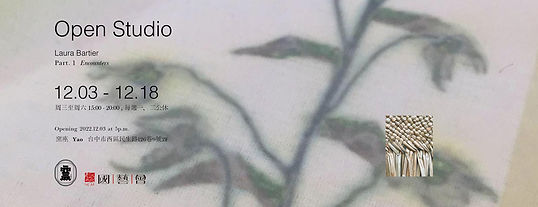
Laura was YÁO’s first international artist-in-residence, and her residency marked our first attempt at a long-term residency programme. Originally, we had planned for her to complete her work and hold an exhibition during the three-month residency. But once we began living and working together, we quickly realised things weren't going to unfold quite as expected.
Looking back, I think we were all having a little too much fun during those three months.
Laura hardly ever stopped. From Taipei to Tainan, Taichung to Taitung, she collected fragments of landscapes, stories and local anecdotes about places that even Taiwanese people might not know about. She also visited people who continue to practise crafts passed down through generations. She travelled with us to places such as Taitung and Miaoli, learning traditional techniques including ramie thread making, weaving and rush weaving. Beyond these visits, she made connections of her own, went hiking, travelled and experienced different ways of living.
From rush weaving to ramie thread making, many of these exchanges took place through the quiet act of working together. Even without a shared language, craft itself became another form of communication, allowing her to understand cultural experiences that are difficult to convey through words alone. These experiences proved far richer, and more important, than we had initially imagined.
Laura explained that many of the works she wanted to develop would require more time to process and produce. The equipment needed for large-scale weaving, sourcing materials and the time involved in making the work were all difficult to accommodate within a short stay in Taiwan. After discussing this together, we decided to change the direction of the residency. Rather than expecting a finished body of work and an exhibition within three months, we divided the programme into two stages. The first would focus on everyday life, research and exchange, with an Open Studio providing an opportunity to share her research and experiences from the residency. Once the work had developed further, Laura would return to YÁO for a formal exhibition.
Compared with a finished exhibition, the Open Studio was more like a working space opened to the public.

Laura brought together the notes, recordings, photographs, collected materials, textile experiments, and the people and stories she encountered throughout her residency, making them part of the exhibition space. Rather than seeing a finished artwork, visitors were invited to witness how a work gradually takes shape, while also discovering local cultures and ways of life that even people in Taiwan may not be familiar with.


This Open Studio took the form of an installation, bringing together textiles, paintings, texts and audio recordings to create an ‘environment’. Departing from her previous practice, Laura began experimenting with collecting and combining different materials from various places, including fibres derived from plants, animals, humans and man-made sources, weaving them together. Inspired by the artist Igshaan Adams, her weaving began to move beyond the flat surface and into three-dimensional space, gradually developing sculptural forms.


This residency also changed the way we think about residency programmes. We began to understand that what truly matters is not necessarily completing a work within a limited period of time, but giving artists enough time and space to understand a place and build relationships with its environment, people and culture. The work itself can gradually take shape once the research has had time to develop.
In-Between
2024.07.13 - 08.18

Since Laura returned to Paris in 2022, we have continued to follow, across a six-hour time difference, how she has gradually woven her experiences and encounters in Taiwan into her work.
“How are we living in a better world?”
Over the years we have known Laura, we have often sensed her returning to this question about modern life, one that may have no clear answer. It comes from her attachment to the environment, as well as her concern for different forms of life and ways of being. In her practice, humans do not occupy the centre of the world. Plants, animals, objects and environments are interconnected, coexisting in relationships without a fixed hierarchy.
‘I feel that I am in a state of chaos at the moment,’ Laura once said of herself.
And this sense of chaos gradually became her way of creating worlds. Her works grow somewhere between abandonment and flourishing: moving across water, clinging to trees, erupting from the ground, while also acidifying, corroding and drying out. Elements of science fiction, dreams and realities beyond the familiar intertwine, forming an imagined environment that is both full of life and constantly disappearing.
If Laura in 2022 was like a spider weaving its web, exploring, moving through and making connections within a ‘known environment’, then two years later, on her return to YÁO, she began to shift from exploring environments to creating them. After two years of reflection and development, the things she had once observed, encountered and collected were gradually absorbed and transformed, taking on new forms through weaving, painting, sculpture and installation.
As the exhibition title In-Between suggests, these works exist at the boundaries between different states: life and death, nature and civilisation, tradition and the contemporary, and centre and periphery. Laura brings together traditional weaving techniques and contemporary methods of making. For her, different media are not separate categories, but different ways of understanding environments and building relationships. Like roots extending outwards, fibres create connections between things that might otherwise never meet, reminding viewers that humans are only one part of a world that is both vast and intricate.
The flowers growing through cracks and the species surviving among ruins in her works also extend Laura’s reflections on culture and tradition. As modern life gradually distances us from the cultural contexts we have inherited, how can traditions be understood when our knowledge of them remains incomplete? And how might they continue to grow?

L'Amante 2024
300 × 180 × 100 cm
Braided, wrapped, and embroidered metal threads, cotton threads, wool, and grasses.
“The mask is the most intimate and autobiographical piece
I’ve ever created.”
L’Amante was completed during Laura’s residency at Villa Panthéon in France from 2023 to 2024. The origins of the work can be traced back to her residency in Taiwan in 2022. During that time, she studied under Abus, a Bunong craftsperson, learning how to harvest ramie, spin thread, dye fabrics and use a belt loom. Through her interactions with various craftspeople, hunters and tribal culture, she gradually began to rethink the relationship between craftsmanship, the body and the natural environment. Upon her return to France, Laura incorporated these experiences into her own working method. Using the architectural structure of her studio as a giant weaving frame, and with the assistance of friends and family, she spent over 1,500 hours creating a four-metre-long double-layered fabric, gradually developing it into L’Amante.
Woven from metal, plant materials and dyed threads, the work is both a sculpture and a wearable mask. Plant forms and insect heads are combined within it, forming a chimera that exists between humans, nature and other forms of life. The title of the work is inspired by Shigeatsu Hatakeyama’s : ‘The Forest in Love with the Sea’, pointing to the interdependent relationships between different forms of life and their ecological environments.
For Laura, donning the mask is also an act of ‘transformation’. She envisions this process as the metamorphosis of an insect: one’s original identity is temporarily loosened, and the body enters a different state of being. L’Amante thus extends from sculpture into performance, bringing the originally static work to life through the dancer’s body, movement and voice. This physical language is also linked to her experiences in Taiwan. Whilst language once served as a limitation in Laura’s understanding of an unfamiliar environment, it also led her to adopt observation and the imitation of bodily movements as an alternative means of comprehension. From textiles, pottery, glasswork and woodwork to singing, hunting and tattooing, she observed that much knowledge is not merely conveyed through words, but also resides in the postures and gestures honed through repeated practice.
These gestures were later reimagined as the performative language of L’Amante, incorporating actions such as thread-making and weaving that she encountered in Taiwan, as well as the craft techniques passed down by Abus and Lu Jinxia. They are no longer merely methods for creating objects, but are reinterpreted through the dancers’ bodies, establishing new relationships between people, plants, insects and the environment.
L’Amante has been performed in both France and Taiwan. Both productions followed the same creative concept and were developed in collaboration with different dancers, utilising sound works composed by the experimental musician Syham Khelifi.
Paris / 2024


Taiwan / 2025

When L’Amante returned to Taiwan for exhibition, Laura and the curator reworked the performance so that it not only centred on the work itself but also responded to the overall In-Between exhibition. The performance featured twin dancers U SENG IO and U SENG I, echoing the recurring motifs of mirror images, symmetry and dual bodies in Laura’s work, whilst once again collaborating with experimental composer Syham Khelifi.
Taking the masks from L’Amante as their starting point, the two dancers moved between the exhibition space and the artworks, using their bodies to connect different materials and narratives, as if on a meandering exploration and reinterpretation of the exhibition.
Laura imagined In-Between as an environment in a constant state of transformation and mutation. Visitors enter a space that is both a gallery and an apartment once inhabited. The works are scattered throughout like different species: growing along the floor, suspended in the air, clinging to surfaces or occupying corners of rooms. Plants, insects, minerals and unrecognisable life forms intertwine, creating a surreal and unfamiliar landscape.
‘I speak of the idea of wasteland, where every species, every element that makes it up, claims its own territory within the same space.’ — Laura Bartier

Compared to a ‘garden’—which is organised, categorised and controlled by human hands—Laura’s work is closer to the concept of a ‘wasteland’. Wild plants therefore recur frequently in her work—those plants that are often overlooked, regarded as harmful, or even those that grow from cracks and gradually encroach upon civilised architecture. Here, nature and culture are not separate from one another; nor are plants merely plants, but gradually become a language through which she understands the environment and forges connections.
The exhibition preserves the original architectural features and traces of daily life within the kiln site, allowing the works to permeate the windowsills, walls, floors and spaces of the rooms. As visitors move through the space, it is as though they are entering a wasteland created by Laura, searching for signs left by different forms of life amongst the weavings, sculptures, paintings and objects she has collected along the way.


Plant printing is one of the creative techniques Laura repeatedly employs in her work. She juxtaposes natural and chemical dyes: whilst chemical dyes leave behind vivid and complete plant forms, natural dyes gradually fade and disappear over time. Rather than deliberately fixing the colours or preventing the materials from changing, she allows her works to continue to evolve over time.
This concept of ‘imprints’ also recurs frequently in Laura’s work. Whether in textiles, metal or ceramics, the transformation and fading of materials are not viewed as a deterioration of the work, but rather as an integral part of its ongoing evolution.


Jacquard weaving is a key creative method Laura uses to transform images from her paintings into fabric. The patterns are not printed or embroidered onto the fabric afterwards, but are formed by the interlacing of warp and weft threads during the weaving process. Laura uses plants, animals and insects as her primary motifs, recombining and transforming real-world species to create life forms that exist somewhere between the familiar and the unfamiliar.
These intertwined and coexisting forms of life not only highlight the interdependent relationships between species, but also extend her imagination regarding mutation, hybridisation and the non-human world.


Laura found a batch of re-dyed fabrics at the market. Stallholders re-dye unsold fabrics and put them back on the market for sale; the original colours are thus covered by a new layer of dye. Laura uses bird feathers as brushes, dipping them in bleach to paint directly onto the fabric. As the dye gradually fades, the original colours beneath slowly emerge.
It is impossible to sketch out the design in advance; once the bleach is applied to the fabric, it takes some time before the actual marks and colours become visible. Laura must continue painting without knowing the full outcome, allowing the image to gradually emerge as the bleaching takes effect.

A work created across Taiwan and France
Most of the works in the exhibition were produced by Laura after she returned to France and then shipped to Taiwan for display. This piece, however, spanned both locations from the very beginning.
Laura first fired the ceramic components in France, planned the overall structure according to her sketches, and then brought some of the parts back to Taiwan. One of the key reasons she wished to complete the piece in Taiwan was that a crucial element of the work could only be realised through Ms Lu Jinxia’s rush-weaving technique. Upon her return to Taiwan, Laura discussed the assembly process with the curator and commissioned metal artist A-Jian to fabricate the metal framework according to the sketches, after which Ms Lu Jinxia wove the rush into the structure. The ceramic pieces from France, the metal framework produced in Taiwan, and the rush weaving were finally brought together at the kiln site and assembled into their final form.
Consequently, this work was not truly completed until the final week of the exhibition, becoming part of the ongoing process of creation throughout the In-Between exhibition.

Research Arichive
2022 Taiwan Residency: Foraging, Travelling, Craft Learning, Fieldwork In 2022, I travelled to the mountainous region of Taitung, where I was welcomed by a Paiwan tribe and began to understand how they establish animistic relationships with rivers, mountains, forests, the sea and all living things. This community has passed down traditional skills such as weaving, tattooing, dancing, singing and hunting from generation to generation. I met Sakinu Ahronglong, a member of the Paiwan tribe. He is a forest ranger and the founder of the Taitung Hunters’ School. He taught us how to understand ourselves through our ancestors, nature and history. As a key figure in safeguarding sacred sites, Sakinu transformed my understanding of the ethics of hunting. For him, hunting an animal involves weeping, celebrating, adorning oneself, sustaining life, sharing, gathering, praying to the spirits of the land, and giving thanks to the earth.

Travelogue
It all started before Laura arrived in Taiwan. Back then, all our conversations took place over video calls. This was YÁO’s first residency programme, and we weren't quite sure where to begin either. So we decided to start with what Laura wanted to explore. During an exchange programme in Japan, Laura had interned at the studio of a kimono maker. The craftsperson made each kimono entirely by hand, from raising silkworms, spinning silk, dyeing and weaving the fabric, to sewing the final garment. The whole process was so time-consuming that only one kimono could be completed each year. Laura told us that her time in the studio felt less like work and more like learning about life, nature, and the relationship between people and their environment. The experience profoundly changed the way she understood these connections. So when she came to Taiwan for the residency, what she wanted most was to meet craftspeople working in different fields, and perhaps even have the chance to learn from them.